Summary
- Dates: February 16–20, 2026, New Delhi, India
- Over 80 countries and 500 tech leaders and researchers in attendance
- Adoption of the New Delhi Declaration for “safe, trustworthy, and robust” AI
- Inclusion of the Global South and international cooperation at the heart of discussions
- Notable speech: Emmanuel Macron emphasized the importance of rules that strike a balance between innovation and regulation
From Paris 2025 to New Delhi 2026: a global vision
The Paris summit laid the groundwork for European regulation, with discussions on the AI Act, worker protection, and the balance between innovation and ethics.
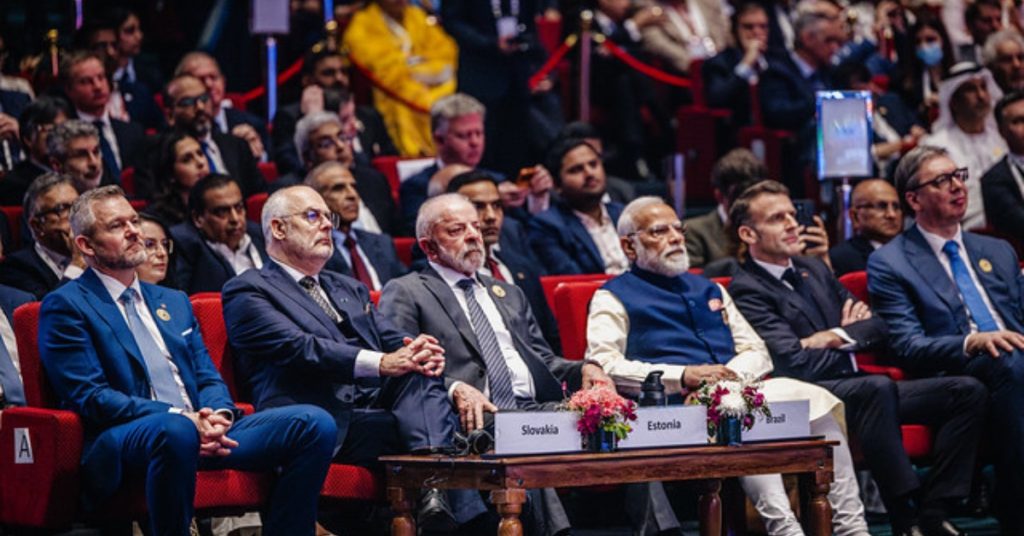
This year, India hosted leaders from over 80 countries, including Narendra Modi, Emmanuel Macron, and Luiz Inácio Lula da Silva, as well as major companies such as Google, OpenAI, Microsoft, NVIDIA, and Qualcomm…
These stakeholders participated in panels and discussions, demonstrating that AI governance is as much a matter for states as it is for major private actors
In New Delhi, the scope broadened:
- Adoption of an international declaration, signed by 91 countries, calling for “safe, trustworthy, and robust” AI
- Emphasis on the inclusion of the Global South to reduce technological inequalities
- Discussions on infrastructure, digital sovereignty, and sustainability
This development shows that AI is no longer just a European or national issue, but a global challenge requiring cooperation and shared governance.
Major announcements and issues
New Delhi Declaration
The final declaration emphasizes the need for responsible and collaborative AI, with a focus on:
- Security and trust in AI systems
- Equity in access to technologies
- International cooperation to avoid regulatory fragmentation
Inclusion and sustainability
The summit emphasized:
- The integration of Global South countries into technological initiatives
- Reducing the energy footprint of data centers and AI models
- The use of more efficient models tailored to real-world needs
Governance and Regulation
Emmanuel Macron’s speech was notable: he called for a balance between innovation and regulation, noting that too many rules could stifle the ecosystem, while a lack of framework would leave room for abuse..
What this means for businesses
The New Delhi Summit sends several signals:
- AI regulation is becoming international and collaborative
- Responsible AI is now a global standard
- Technological competition is intensifying, with implications for European strategies
- Businesses must integrate these developments into their innovation and compliance strategies
Conclusion: toward Geneva 2027
The 2026 New Delhi Summit confirms that artificial intelligence is no longer just a national or European issue: it is a global challenge requiring cooperation, inclusion, and shared governance.
While Paris 2025 laid the groundwork for European regulation and New Delhi 2026 expanded the scope to 91 countries and major tech companies, the Geneva 2027 summit will be an opportunity to consolidate these international rules and assert responsible leadership in AI.
For businesses, this summit sends a clear signal: responsible AI is now a global standard. Adopting these new practices today means gaining a head start in transforming the customer experience. The next summit, scheduled for Geneva in 2027, is expected to continue this global momentum.
You too can jump on the AI bandwagon and transform your customer experience! Request a demo now
Share this article!