
As the market experiences a resurgence in activity, driven by stabilizing prices and falling interest rates, more households are reviving their plans to buy. This is also having an impact on rentals, with demand on the rise again, much to the delight of real estate agencies.
But this momentum also brings its share of challenges: managing a growing volume of requests, often through digital channels, with customers who expect quick and personalized responses.
It is in this context that conversational AI comes into its own. Deployed in the form of a chatbot or callbot, it allows agents to pre-qualify candidates and respond immediately to recurring questions. This frees up time to follow up on priority files. With solutions such as those offered by Dydu, AI simplifies management and provides both a better customer experience and greater efficiency for teams.
The search for housing: a daily challenge
Searching for housing, whether to buy or rent, remains a difficult and time-consuming process. Candidates take multiple steps: consulting listings, calling agencies, and submitting applications online or in person. This process, already complex for the applicant, generates a considerable administrative burden for real estate agencies.
From search to allocation, a process simplified by AI
Faced with these issues, the main advantage of conversational AI lies in its ability to automate critical but time-consuming steps in the applicant’s journey:
- Finding the right housing: Real estate chatbots provide accurate information on available housing, eligibility criteria, and assistance programs (APL, income limits). As a result, applicants save time and can more quickly identify offers that match their situation.
- Help with putting together the application: Reminders of the necessary documents, automatic follow-ups in case of missing documents.
- Smart pre-qualification: Filtering of applications that do not meet the criteria to optimize processing by teams, by rejecting applications that are clearly outside the scope and redirecting them to the right contact person if necessary.
- Management of peak activity: During rental campaigns or program launches, the chatbot absorbs the volume of interactions without additional delay.
For example, a woman looking for an apartment interacts directly with an agency chatbot:
In a matter of seconds, the chatbot analyzes her criteria and offers a pre-selection of relevant listings tailored to her preferences.
It immediately reminds her of the list of documents to be provided to complete the application, checks her eligibility for certain subsidies, and allows her to make an appointment for a viewing. Whereas previously the candidate would have had to contact several real estate agencies and wait several days, the experience is now immediate, targeted, and reassuring.
The effectiveness is already measurable: in 2024, CDC Habitat’s chatbot automated more than 155,000 conversations, 92% of which were successful. And this success is not limited to the search: once settled in, tenants also benefit from ongoing assistance thanks to conversational AI.
Tenant management and support
In the rental market, day-to-day management remains “burdensome” for both tenants and agencies. Between organization, property maintenance, and administration, each task can quickly take up time and generate dissatisfaction.
Bots are gradually becoming facilitators capable of simplifying many everyday tasks:
- Frequently asked questions: rent, utilities, certificates, payment terms.
- File tracking: real-time notifications, progress updates.
- Everyday life: reporting technical issues, tracking complaints, uploading insurance certificates.
- Changes of residence: formalities related to moving, simplified arrival or departure.
This ongoing support guarantees a smooth experience for the tenant while freeing teams from repetitive requests.
Conversational solutions are now extending to more sensitive or even critical situations: maintenance, debt collection, or emergency management.
When AI turns the unexpected into immediate solutions
Tenant calls are not only about administrative procedures: they also concern everyday incidents, technical emergencies, and payment-related questions. In all these cases, the ability to quickly qualify the request is crucial.
1. Call pre-qualification: a structured process
When a tenant contacts their landlord, via a callbot for example, the callbot automatically identifies the caller via the ERP/CRM and asks a few targeted questions to clarify the reason for the call. There are three main scenarios:
- Simple request: the bot provides the answer directly (for example, how to obtain an insurance certificate) and generates a ticket that is automatically resolved.
- Complex request: the callbot creates a ticket in the rental management system, documented and ready to be processed by a human manager at a later stage (e.g., heating failure requiring technical intervention).
- Emergency: if the severity is confirmed (water leak, power failure, etc.), the call is immediately escalated to an advisor or on-call service.
In summary, here is how the process works:
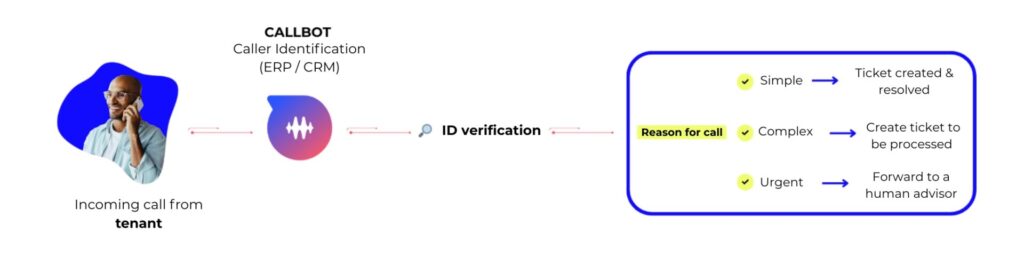
This process not only allows calls to be filtered and categorized, but also determines in advance whether the incident is the responsibility of the tenant (minor repair) or the landlord (technical intervention). The result is better resource allocation, fewer unjustified interventions, and smoother handling of critical situations.
2. Rent collection and follow-up: proactive communication
The same logic of qualification and automation applies to collection. Conversational AI makes it possible to:
- Automatically remind tenants of payment deadlines,
- Notify them of late or unpaid rent as soon as it is detected,
- Propose appropriate solutions (payment plans, referral to a specialist advisor).
This lightens the load on teams, who are often busy with repetitive reminders, while ensuring clear and proactive communication with tenants.
Automation at the service of real estate agencies
Faced with a real estate market that is regaining momentum and teams that are often overwhelmed, conversational AI is now establishing itself as a facilitator for streamlining the customer journey. From finding accommodation to day-to-day management and administrative follow-up, chatbots and callbots make it possible to meet tenants’ expectations in terms of responsiveness, availability, and simplicity, while optimizing the internal resources of landlords and developers.
With its sector expertise and proven solutions, Dydu supports real estate players in this transformation by designing conversational assistants tailored to their needs and capable of integrating into their business processes.
Are you a landlord, developer, or property manager looking to improve your teams’ responsiveness while offering better service to your customers?
Share this article!